
Construction Company in Libya: How to Select an International Contractor
What procurement teams should look for in a construction company in Libya, from delivery models and local presence to safety, quality and supply chain control.
Choosing a construction company in Libya is one of the most consequential decisions a project owner will make. The contractor you appoint determines whether design intent survives procurement, whether materials arrive when the program needs them, and whether the finished facility can actually be operated. In a market where demand is rising but delivery conditions remain demanding, the gap between a capable contractor and an inadequate one shows up quickly in cost, schedule and quality.
This guide is written for procurement managers, project directors and development teams who are evaluating a construction contractor in Libya. It covers the current market context, the delivery models worth considering, and the practical questions that separate a credible international contractor from a bid that looks good only on paper.
ZALA Global approaches these questions as an international group with a regional office in Benghazi and a track record built largely in complex environments abroad. Where we refer to our own experience, we say exactly where it comes from.
Why demand for construction projects in Libya is growing
Construction projects in Libya draw on several sources of demand at once. The first is long-deferred building activity. According to Oxford Business Group's 2024 report on Libya, around 300,000 housing units have been on hold since 2011, and many remain unfinished because of contractors' security concerns and difficulties securing government finance.
The second is disaster recovery. Storm Daniel and the flooding of September 2023 hit eastern Libya hard. A joint World Bank, EU and UN Rapid Damage and Needs Assessment estimated recovery and reconstruction needs at about $1.8 billion and found that roughly 70 percent of those costs relate to infrastructure, with housing the largest single component. More than 18,500 homes were destroyed or damaged, and transport and water were among the most affected sectors.
The third is a broader program of public works. A reconstruction fund created in 2024 to rebuild Derna has since grown into the Libya Development and Reconstruction Fund, and international reporting describes bridges, apartment blocks, schools and hospitals under way across the east. Long-stalled national infrastructure is also moving again: in November 2025, Libya and Italy signed an agreement to build a 160-kilometer section of the coastal highway toward the Tunisian border, work that had stopped in 2011.
For owners, the implication is simple. Many projects are competing for the same pool of qualified engineers, equipment and materials. Contractor selection needs to test real delivery capacity, not just price.
What a construction contractor in Libya actually has to manage
Every construction company claims to deliver on time and on budget. In Libya, the claim has to be backed by an answer to a specific set of operational problems.
- Procurement and logistics. A large share of specialized equipment and building systems is imported. The contractor must plan long-lead items early, manage customs and port clearance, and hold buffer stock where the schedule cannot absorb delays.
- Workforce. Skilled trades, supervisors and engineers have to be mobilized, accommodated and retained, often with a mix of local and international staff.
- Design coordination. Drawings prepared to international standards still need to be adapted to local materials, utility connections and authority requirements.
- Quality and safety. QA/QC and HSE systems must work on site every day, not only in the tender submission.
- Regulation. Foreign participation sits within a legal framework that includes Law No. 9 of 2010 on Investment Promotion, Law No. 23 of 2010 on Commercial Activity and implementing ministerial decisions on foreign companies' branches. Requirements change, so owners and contractors should confirm current rules with Libyan counsel.
A general contractor that cannot explain how it handles each of these points, with named people and systems, is a risk regardless of its headline price.
Choosing a contracting model
How the contract is structured matters as much as who signs it. The main options for a contracting company in Libya are:
- Traditional design-bid-build. The owner completes the design, then tenders construction. This gives the owner close control over design but places interface risk between designer and builder on the owner.
- Design and build. One contractor carries both design and construction responsibility. It shortens schedules and reduces disputes over design gaps.
- EPC. Engineering, procurement and construction under a single contract, typically with a defined performance outcome. We cover this model in detail in our guide to choosing an EPC contractor in Libya.
- Turnkey. The contractor hands over a complete, commissioned facility ready for use. See our article on turnkey building construction in Libya for how scope and acceptance are usually defined.
ZALA Global's construction and contracting services are structured around turnkey, EPC and design-build delivery, covering concept development, design coordination, engineering, procurement, construction management, site execution, commissioning and operational readiness.
What to look for in a construction company in Libya
When comparing an international construction company in Libya against local alternatives, owners should look past brochures to evidence.
Relevant project experience
Ask for projects of comparable type, scale and operating environment, with scopes described in detail. A contractor that has delivered in remote, high-security or logistically difficult settings will have already solved many of the problems a Libyan site presents.
A real presence in the country
An international contractor in Libya needs people on the ground who understand local suppliers, authorities and labor markets. A regional office is not a guarantee of delivery, but its absence is a warning sign.
Systems that survive pressure
Request examples of QA/QC plans, HSE records and project controls from previous work. Strong contractors can show how these systems operated on live projects, including how they handled schedule recovery.
Financial and supply chain resilience
Large projects require the contractor to carry cost before payment arrives. Ask how the contractor finances mobilization and secures materials when supply lines are disrupted.
How ZALA Global fits this profile
ZALA Global is an international construction, operations and investment group headquartered in Istanbul, with eight offices including a regional office in Benghazi. Our wider global presence covers more than 20 countries of operation, and the group's contracting legacy dates back to 1962.
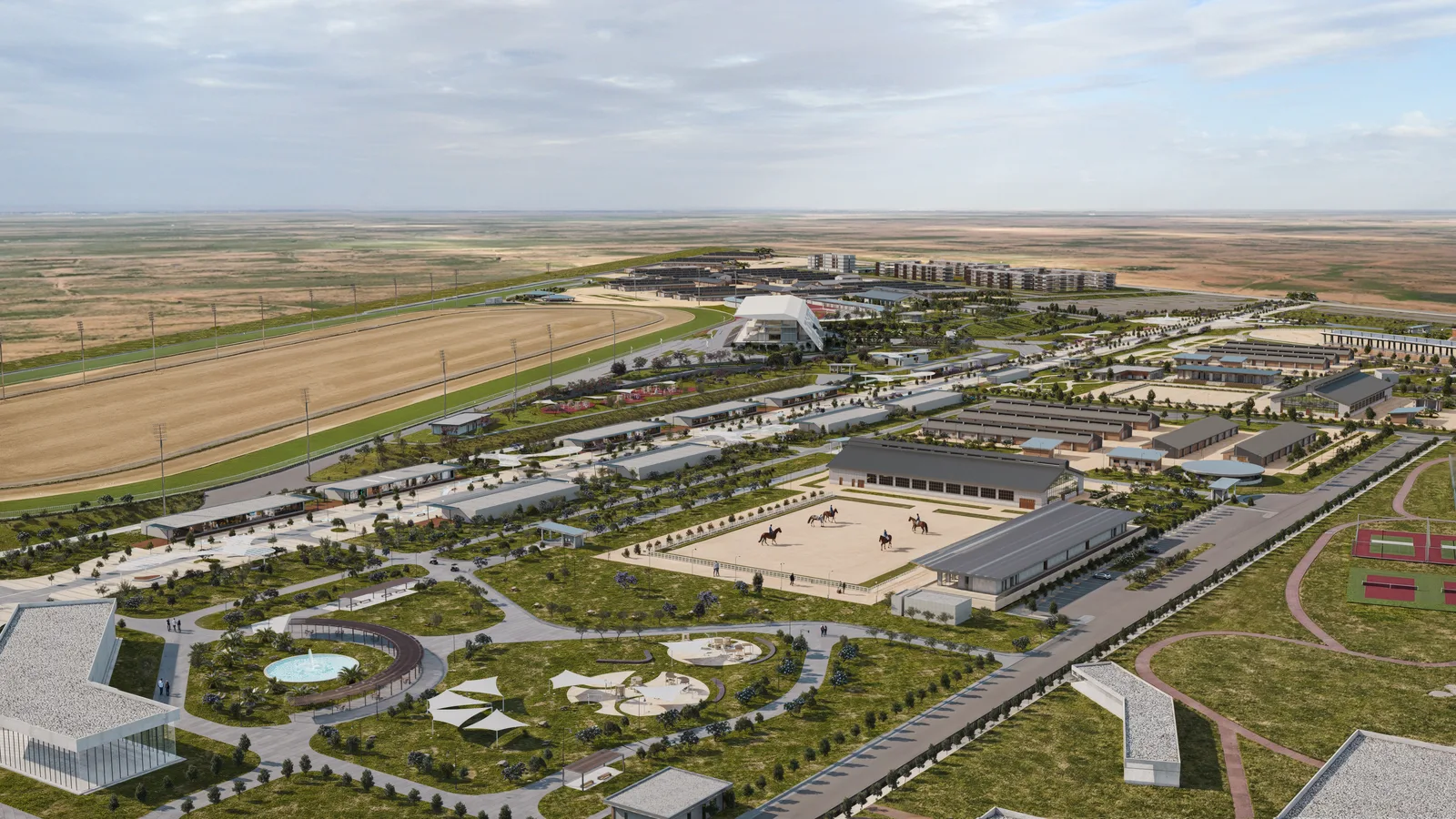
In Libya, our current flagship is the Benghazi Hippodrome Project, initiated in 2025. It is a large-scale equestrian and mixed-use development on a 1.5 million m² site, including racing tracks with sand and turf surfaces, stables, a horse hospital, a horse museum and spectator areas, alongside a hotel, mosque, shopping center, landscaping and site infrastructure.
Most of our track record sits outside Libya, much of it for government, diplomatic and military clients in demanding settings. Examples include the New U.S. Embassy Compound in Ankara, where ZALA managed all aspects of construction on a 37,000 m² site, including QA/QC and HSE, as well as airfield, utility and facility projects in Afghanistan, Iraq and Kyrgyzstan and port works at Duqm in Oman. That experience in complex, high-risk environments is what we bring to construction projects in Libya.
Frequently asked questions
Can a foreign construction company work directly in Libya?
Yes, foreign companies can operate in Libya, typically through a registered branch, a joint venture or other structures permitted under Libyan commercial and investment law. The rules have been revised several times, so the current requirements should always be confirmed with Libyan legal advisers before tendering.
What is the difference between a general contractor and an EPC contractor?
A general contractor usually builds to a design provided by the owner. An EPC contractor takes responsibility for engineering, procurement and construction together and is accountable for delivering a working facility, which shifts more interface risk away from the owner.
Which sectors are driving construction demand in Libya?
Housing, transport, water and public buildings are major drivers, particularly in areas affected by the 2023 floods. Long-delayed housing and highway programs are also part of the pipeline.
Does ZALA Global have an office in Libya?
Yes. ZALA Global has a regional office in Benghazi, the city where the group initiated the Benghazi Hippodrome Project in 2025.
Talk to our team
If you are planning a building or infrastructure project and are evaluating a construction company in Libya, we would welcome the chance to discuss scope, delivery model and logistics with you. Contact ZALA Global to arrange an initial conversation with our construction team.
Work with us
Planning a project? Talk to our team.
Related articles
Construction Project Management in Libya: How to Keep Complex Projects on Schedule
A practical look at construction project management in Libya, from early planning and procurement to site controls, quality, safety and handover.
EPC Contractor in Libya: How Engineering, Procurement and Construction Work Together
A practical guide to EPC contracting in Libya: what single-point responsibility covers, where the risks sit, and what owners should ask before awarding an EPC contract.
Infrastructure Construction in Libya: Roads, Water, Sewage and Utility Networks
Roads, water treatment, sewage and utility networks are at the center of Libya's recovery. Here is how infrastructure projects are delivered and what owners should expect from a contractor.