
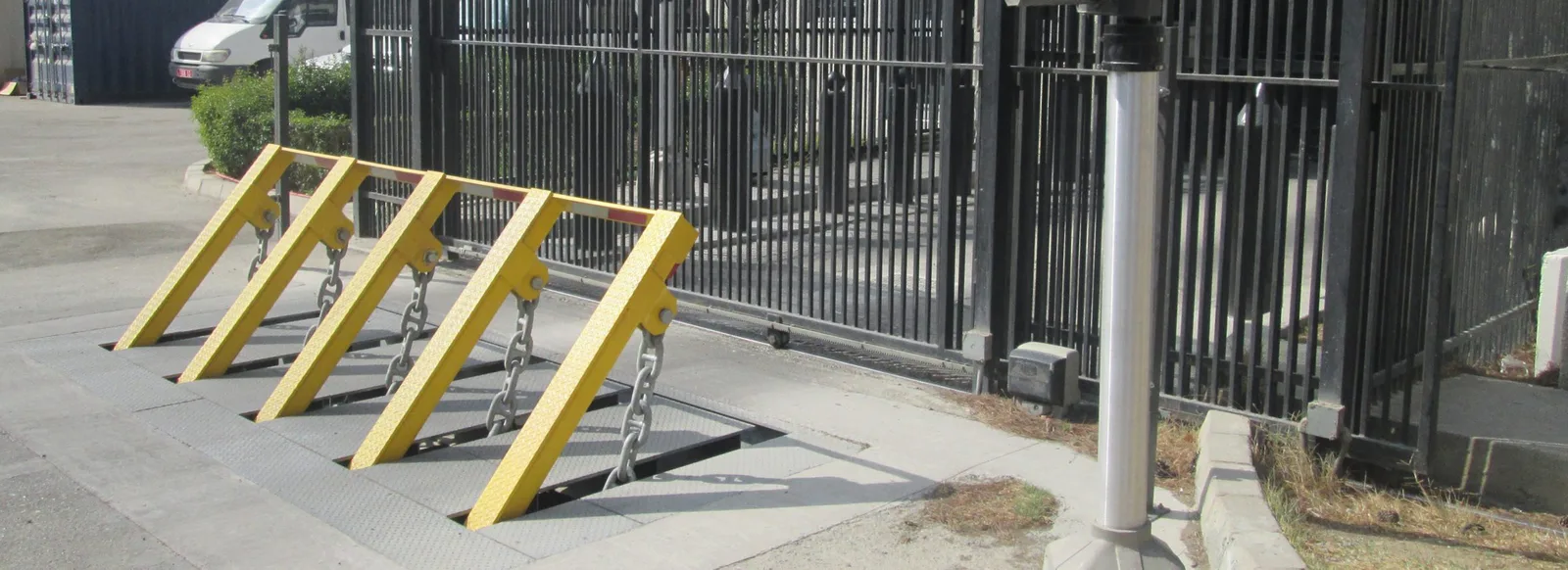
Secure Facility Contractor: Embassies, Military Facilities, Airfields and Ports
Embassies, military bases, airfields and ports demand more than standard construction. Here is what separates a capable secure facility contractor, with examples from ZALA Global's project record.
A secure facility contractor works under conditions most construction companies never meet. The client may be a government department, a defense agency or a diplomatic mission. The site may be inside an operating base, next to an active runway or within a compound that cannot close. Design standards are prescriptive, personnel and materials are controlled, and the finished asset has to perform from the day it is handed over.
Embassies, military facilities, airfields and ports share these traits even though they look very different. Each is mission-critical, each is built to owner-specific criteria, and each usually has to be delivered while the surrounding operation keeps running.
This article explains what distinguishes special projects construction, what buyers should test for when selecting a contractor, and how ZALA Global's record across diplomatic, military, airfield and port projects informs its approach.
What makes a secure facility contractor different
Standard commercial construction is driven by cost, schedule and building codes. Secure and special-purpose facilities add layers that change how the whole project is run:
- Owner criteria on top of codes. Government and defense clients specify their own design and construction standards, and compliance is inspected, not assumed.
- Controlled supply chains. Certain materials, products and systems must be sourced, tracked and stored under defined procedures.
- Vetted personnel. Workforce access is managed, and roles may be restricted by clearance or nationality.
- Live operations. Work often happens inside an occupied site, so phasing, access and safety plans must protect the client's mission.
- Documentation. Quality records, test results and as-built information form part of the deliverable.
A contractor that treats these as paperwork rather than core processes will struggle. The capability is organizational: QA/QC, HSE, document control and site management built for oversight.
ZALA Global's lineage in this field goes back decades. The group's history records construction works for NATO facilities in Malatya in 1964 and, later, NATO-related facilities and housing for American and Turkish personnel. Its client list includes NATO, the U.S. Army Corps of Engineers, the U.S. Department of State and NAVFAC. These early works established a culture of building to owner criteria under oversight.
Embassy construction contractor: diplomatic compounds and upgrades
Diplomatic construction has been shaped by security requirements for decades. A U.S. Government Accountability Office report describes how the State Department launched a large program to replace insecure and dilapidated diplomatic facilities after the 1998 embassy bombings in Nairobi and Dar es Salaam, with new compounds required to meet stringent standards for setback and blast resistance.
For an embassy construction contractor, this means working to detailed owner specifications and inspection regimes. ZALA Global's diplomatic work includes:
- New U.S. Embassy Compound, Ankara. A new compound on a 37,000 m² site including the chancery, a Marine Security Guard residence, community facilities and support facilities. ZALA provided labor, materials and equipment for surveys, site preparation, geotechnical works, excavation, reinforced concrete buildings and stone cladding, and managed QA/QC and HSE with its own site teams.
- Physical Security Upgrades, U.S. Embassy Baku. Renovation of compound access buildings, including installation of forced-entry and ballistic-resistant doors, foundations for vehicle barriers, and electrical and telecommunications works.
- OBC Compound Rehabilitation, Niamey and Freetown Rain Water Capture and Storage System, the latter including a water treatment plant and storage tanks serving a U.S. diplomatic compound.
Upgrades to occupied compounds are often harder than new builds: the mission keeps working while doors, barriers and systems are replaced around it.
Military facility contractor: building inside operating bases
Military construction combines secure-site procedures with heavy civil and utility scope. A military facility contractor may be asked to deliver housing, utilities, fuel systems, training facilities and protective structures, often on fast-track design-build terms.
ZALA Global's references include bulk fuel storage and supply facilities, a drainage system and a MILCON utilities package at Bagram Air Base. The Eastside Utilities project covered deep wells, water distribution piping, gravity sewer and force mains, lift stations and a wastewater treatment plant expansion. In Baghdad, the JSS Shield design-build project established life support and training facilities on a 10.5-hectare site within an occupied, fully operational government compound. At Sather Air Base, the scope included installing and retrofitting containerized housing pods with protective features.
The common lesson is that utilities and infrastructure decide whether a base functions. Buildings are visible, but water, power, drainage and fuel keep the mission running.
Airfield contractor: runways, taxiways and aprons
Airfield pavements are among the most demanding civil works. Civil aerodromes are designed to ICAO Annex 14, which sets specifications for the physical characteristics of aerodromes and the surfaces around them, while military airfields follow owner-specific criteria. Tolerances on grade, smoothness and materials are tight, and every phase has to be coordinated with flight operations.
A runway construction contractor needs to plan for:
- Phased closures that keep the airfield operational.
- On-site production of asphalt or concrete where commercial supply is limited.
- Foreign object debris control throughout the works.
- Airfield lighting, markings and navigational systems integrated with civil works.
ZALA Global's airfield record includes runway and apron expansion at Incirlik Air Base (2002), the Runway 03/21 repair at Bagram Air Base, and a parallel taxiway and aprons at Bagram. At Bagram, repairs were phased to keep the airfield in operation, and the team set up a 120 t/hr asphalt plant on site. At Manas in Kyrgyzstan, the group completed a design/build repair of Runway 08/26, a strategic airlift ramp and hot cargo pad, and an air traffic control tower with equipment installation.
Port infrastructure contractor: terminals and marine works
Ports combine marine works, heavy pavements, buildings and utilities on large, exposed sites. A port infrastructure contractor must coordinate quay construction, yard paving, drainage, gatehouses, administration buildings and services while vessels and cargo begin to move.
ZALA Global's largest port reference is the Duqm Port Commercial Terminal & Operational Zone in Oman, on a 90-hectare site with a 2.3 km berth for merchant vessels. The scope included container, dry bulk and multipurpose terminal areas and 17 operational and administration buildings, including gatehouses, a transaction building, a pass office, electrical service buildings and customs inspection facilities. The group also delivered channel works at Duqm.
Port investment remains active across the region. In Libya, for example, authorities announced in January 2026 a $3 billion partnership to expand the Misrata port terminal, the country's main non-oil port. ZALA Global, which has a regional office in Benghazi, follows these developments closely; our article on infrastructure construction in Libya covers the wider picture.
How to evaluate a contractor for special projects
When shortlisting contractors for secure or mission-critical work, ask for evidence rather than statements:
- Comparable references with the same type of owner and the same operating constraints.
- QA/QC and HSE systems and how they were audited on previous projects.
- Phasing plans that show how the client's operation continues during construction.
- Self-performance capacity, such as on-site batching plants, equipment fleets and utility crews.
- Operations and maintenance planning. The GAO report found that new embassy compounds carried significantly higher operations and maintenance costs than the facilities they replaced, so lifecycle planning should begin during design.
ZALA Global can support facilities after handover through its life support and base operations services, which include facility management and operations and maintenance.
Frequently asked questions
What is a secure facility contractor?
A contractor equipped to build facilities for government, diplomatic or defense clients under owner-specific standards, controlled procurement, managed personnel access and on-site oversight.
Can runway works be done while an airfield stays open?
Yes, through careful phasing, temporary operating surfaces and coordination with air operations. ZALA Global's Bagram runway repair was phased specifically to maintain airfield operations.
Which delivery models suit special projects?
Design-build and turnkey models are common because they give one contractor responsibility for design, procurement and construction. Several of ZALA Global's military and airfield projects were delivered design-build.
Does ZALA Global work outside its home markets?
Yes. The group has worked in Türkiye, Iraq, Afghanistan, Kyrgyzstan, Oman, Azerbaijan, Niger, Sierra Leone and other countries, and has offices in eight locations including Benghazi, Libya.
Discuss your project
Secure and special-purpose facilities reward contractors that plan for oversight, operations and lifecycle from the start. Explore our construction capabilities or contact ZALA Global to discuss your embassy, military, airfield or port project.
Work with us
Planning a project? Talk to our team.
Related articles
Construction Project Management in Libya: How to Keep Complex Projects on Schedule
A practical look at construction project management in Libya, from early planning and procurement to site controls, quality, safety and handover.
EPC Contractor in Libya: How Engineering, Procurement and Construction Work Together
A practical guide to EPC contracting in Libya: what single-point responsibility covers, where the risks sit, and what owners should ask before awarding an EPC contract.
Infrastructure Construction in Libya: Roads, Water, Sewage and Utility Networks
Roads, water treatment, sewage and utility networks are at the center of Libya's recovery. Here is how infrastructure projects are delivered and what owners should expect from a contractor.